Elysian Insights Reflection
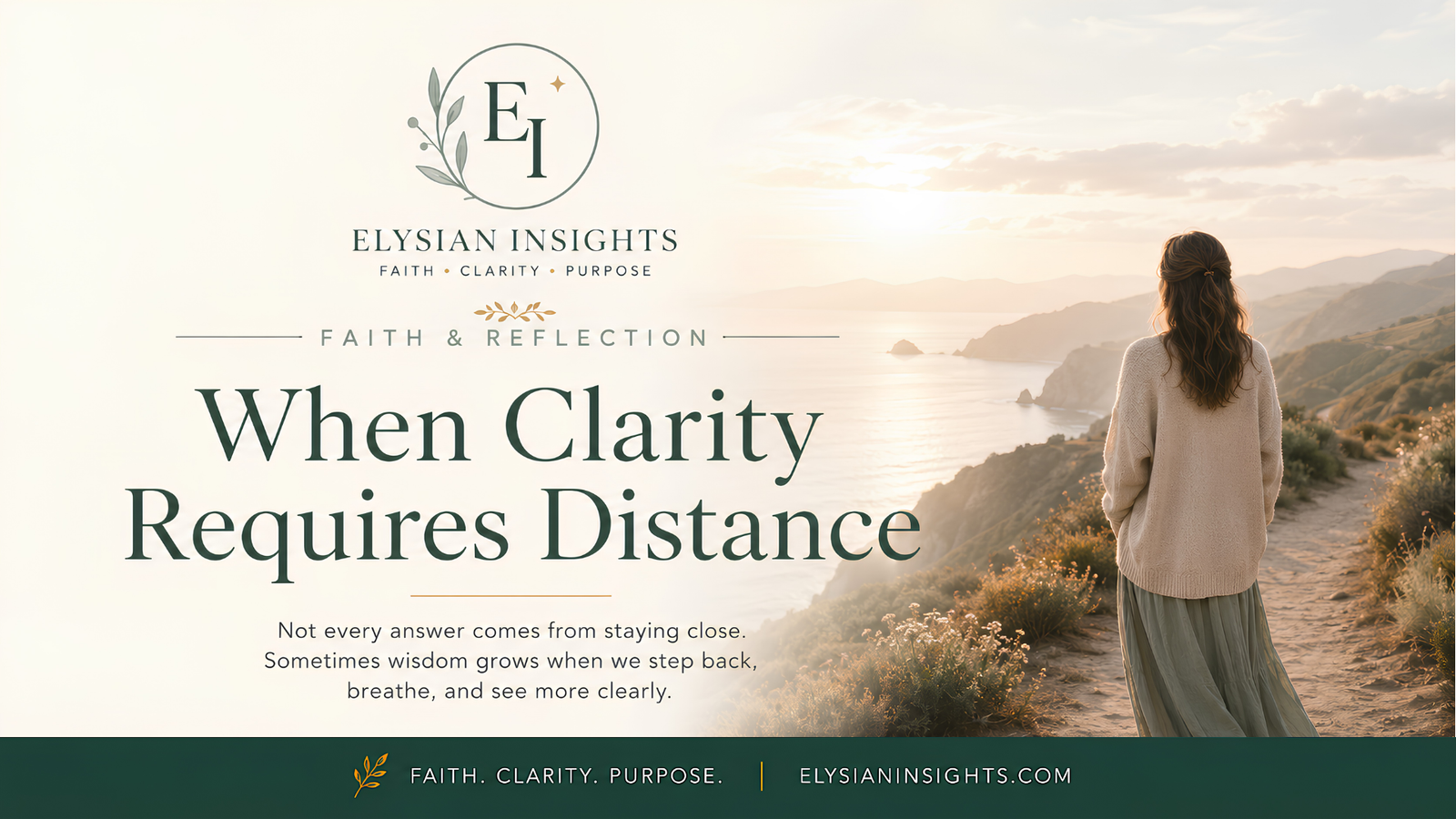
When Clarity Requires Distance
Distance is not always rejection. Sometimes it is the wise space needed to restore perspective, protect peace and hear God clearly.
Opening
Constant closeness can make truth harder to recognise.
Most people move through life without ever slowing down…
We are often taught that staying close, staying available, and staying involved are signs of loyalty, strength, or care.
Sometimes they are.
But sometimes clarity only comes when we step back far enough to see what constant closeness has made difficult to recognise.
Distance is not always rejection. It is not always avoidance. It is not always a sign that love, care, or commitment has disappeared.
Sometimes distance is wisdom.
Sometimes it is the space needed to hear God clearly, examine what is happening honestly, and stop responding from pressure, confusion, or emotional exhaustion.
There are moments when staying too close to a situation can make everything feel urgent. Every message demands an answer. Every change feels personal. Every silence becomes something to interpret.
A little distance can return things to their proper size.
It can help us see what is ours to address, what belongs to someone else, and what needs to be placed fully into God’s hands.
Reflection
Distance removes the illusion that we must manage everything.
Healthy distance can be calm, respectful and free from unnecessary explanation.
Distance can be uncomfortable because it removes the illusion that we must constantly manage what is happening.
When we step back, we are no longer reacting to every movement. We are no longer trying to keep everything steady through our own effort. We are no longer proving our care by remaining endlessly accessible.
That quiet can initially feel unfamiliar.
But within it, important questions begin to surface.
These questions are not invitations to become cold or careless. They are invitations to practise discernment.
Healthy distance does not require hostility. It can be calm, respectful, and free from unnecessary explanation.
You can care without monitoring everything. You can love without losing your peace. You can remain compassionate without remaining constantly available to confusion.
Questions for discernment
Let honest questions separate wisdom from fear.
Am I remaining close because God is asking me to, or because I am afraid of what may happen if I step back?
Am I offering genuine support, or am I carrying responsibility that was never mine?
Is my presence bringing peace and wisdom, or is it keeping me emotionally entangled in something I cannot control?
Would a little space allow truth to become clearer?
Insight
Clarity often requires enough space to separate what pressure merges.
Clarity often requires enough space to separate facts from emotions, patterns from promises, and genuine responsibility from pressure.
When we are deeply involved in a situation, we may begin to respond to how things feel rather than to what is actually happening.
Distance allows us to observe. It helps us notice repeated patterns that urgency may have hidden. It gives us room to recognise whether something is producing peace, wisdom, accountability, and growth—or simply keeping us in a cycle of reaction.
Distance can also reveal what happens when we stop holding everything together. Some situations become healthier because everyone is given room to take responsibility. Others begin to unravel because they were depending too heavily on one person’s constant effort.
Both outcomes provide clarity.
This does not mean withdrawing from every difficult situation. Some responsibilities require presence, patience, and faithful commitment.
But faithful presence is different from fearful attachment. One is led by wisdom. The other is driven by the belief that everything may collapse unless we remain constantly involved.
God does not ask us to prove our faithfulness by abandoning peace, discernment, or healthy boundaries.
There are times when the most responsible step is not another conversation, another explanation, or another attempt to make someone understand.
The most responsible step may be to pause, create space, and allow time, truth, and God’s direction to reveal what pressure cannot.
Distance without disconnection
Wise distance does not always mean ending a relationship, leaving a responsibility, or closing a door permanently.
You may respond less immediately.
You may stop entering conversations that repeatedly produce confusion.
You may choose not to explain a decision that has already been communicated clearly.
You may pray before acting instead of reacting from discomfort.
You may allow another person to experience the natural responsibility of their own choices.
You may stop checking for updates that do not require your attention.
These are not necessarily acts of withdrawal. They can be acts of stewardship.
Your attention is valuable. Your peace is valuable. Your ability to hear God without constant interruption is valuable.
Not everything should have unlimited access to them.
What distance can reveal
Space can expose what constant engagement keeps hidden.
Distance can reveal whether peace returns when you stop engaging.
It can reveal whether a connection is supported by mutual respect or maintained mainly through your effort.
It can reveal whether you were acting from compassion or from guilt.
It can reveal whether the situation truly requires action, or whether pressure merely made it feel urgent.
It can reveal how much emotional energy was being spent managing things that God had not asked you to control.
Most importantly, distance can create room for God to correct your perspective.
You may discover that you need to return with greater patience and understanding. You may discover that a boundary needs to remain. You may realise that the situation is not as serious as it first appeared. You may also recognise that something you repeatedly excused requires honest acknowledgement.
Distance does not always provide the answer immediately. But it often quiets the noise enough for the answer to become recognisable.
Scripture for reflection
“He that hath knowledge spareth his words: and a man of understanding is of an excellent spirit.”Proverbs 17:27
Wisdom does not always rush to speak, respond, defend, or remain involved. Sometimes understanding is shown through restraint. A quieter response can create more clarity than a long explanation. A measured pause can protect more peace than immediate engagement. A little space can prevent us from saying or doing what pressure would later make us regret.
“And he withdrew himself into the wilderness, and prayed.”Luke 5:16
Jesus also withdrew from crowds and demands to pray. Withdrawal was not weakness, indifference, or failure. It was part of remaining spiritually grounded and aligned with the Father.
There is wisdom in recognising when closeness is serving the moment—and when distance is necessary to restore perspective.
A question to carry with you
What situation might become clearer if you stepped back long enough for pressure to settle and truth to become visible?
Closing
Stepping back does not always mean giving up.
There is peace in knowing that stepping back does not always mean giving up.
Sometimes it means refusing to let pressure make the decision for you.
You can create space without becoming unkind. You can protect your attention without becoming unavailable to God. You can care deeply while allowing truth, responsibility, and time to do their own work.
Not every situation needs your constant presence. Not every silence needs to be filled. Not every distance needs to be feared.
Some distance is where confusion settles, perspective returns, and God reminds you that He is still present—even when you are no longer trying to hold everything together.
Create space without hostility. Protect peace without guilt. Let truth become clear.
Sometimes, clarity begins the moment we choose to pause.
Continue reflecting
Let perspective return before deciding what comes next.
Explore more reflections created to support wise boundaries, peaceful discernment and whole-person wellbeing.